
Doing your own car repairs can save you a lot of money, but having the right tools makes all the difference.
You don’t need a massive toolbox or thousands of dollars in equipment to start working on your own vehicle. A solid collection of basic tools can handle everything from oil changes and brake jobs to suspension work and basic troubleshooting.
Here are 10 tools we’d recommend having in almost any home garage.
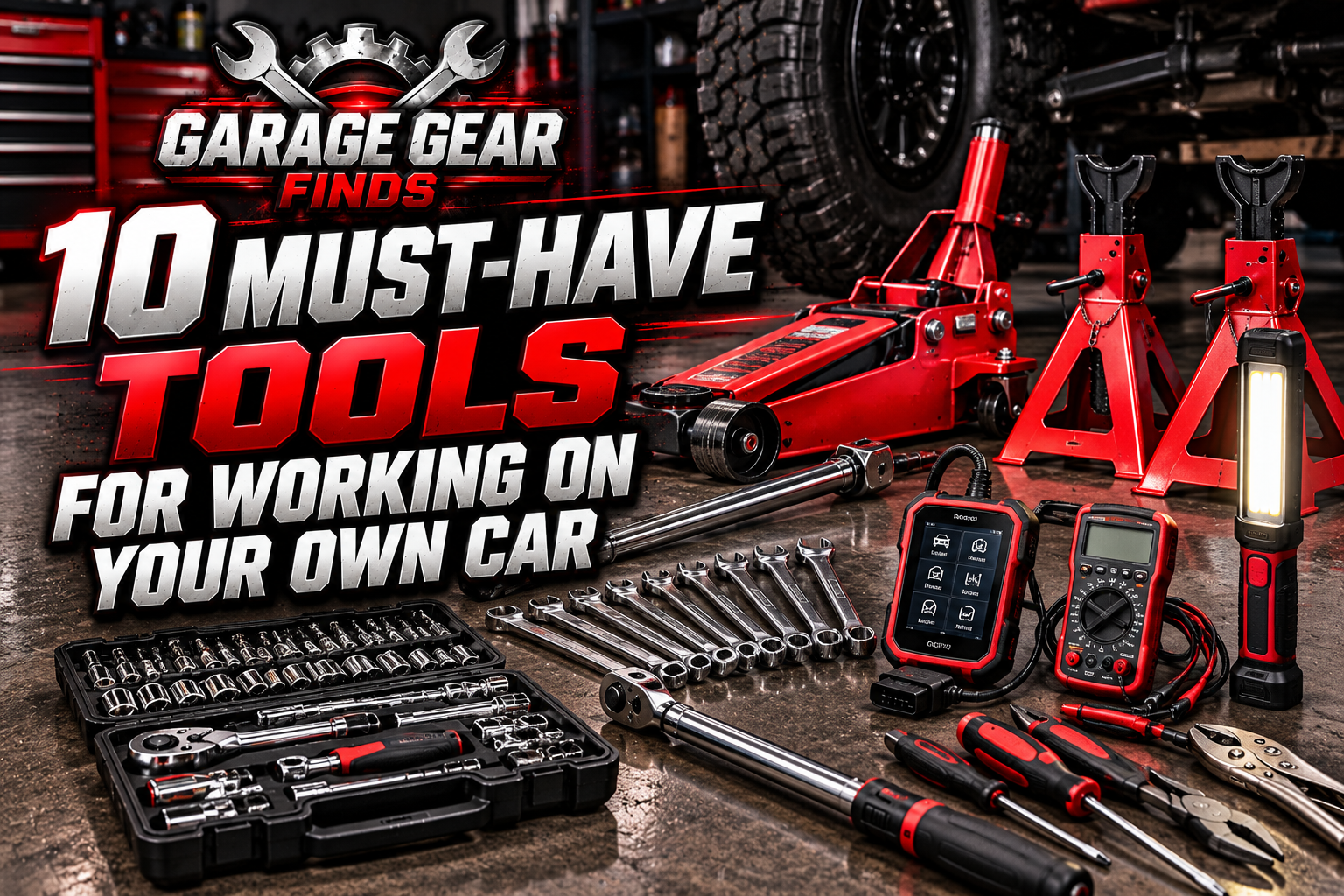
Doing your own car repairs can save you a lot of money, but having the right tools makes all the difference.
You don’t need a massive toolbox or thousands of dollars in equipment to start working on your own vehicle. A solid collection of basic tools can handle everything from oil changes and brake jobs to suspension work and basic troubleshooting.
Here are 10 tools we’d recommend having in almost any home garage.
1. Mechanic’s Socket Set
A good socket set is the foundation of a home mechanic’s toolbox. Look for a set with both metric and SAE sockets, multiple ratchet sizes, extensions, and deep sockets. For most modern vehicles, you’ll probably use the metric side the most.
2. Hydraulic Floor Jack
If you’re going to work underneath your vehicle, a quality floor jack makes lifting it much easier. Make sure the jack is rated for the weight of your vehicle and has enough lifting range for what you drive.
3. Jack Stands
Never rely on a hydraulic jack alone while you’re underneath a vehicle. Once the vehicle is raised, properly rated jack stands should support it at manufacturer-approved lifting/support points.
4. Breaker Bar
When a stubborn bolt won’t move, a breaker bar gives you considerably more leverage than a standard ratchet. They’re especially useful for lug nuts and suspension work.
5. Torque Wrench
Getting a bolt tight isn’t always enough—it needs to be tightened to the correct specification. A torque wrench is especially important for wheels and other components where proper torque matters.
6. Combination Wrench Set
Sockets can’t reach everything. A good metric and SAE combination wrench set will cover plenty of bolts and fittings that a ratchet can’t easily access.
7. OBD-II Scanner
For most 1996-and-newer U.S. passenger vehicles, an OBD-II scanner can read diagnostic trouble codes when the check-engine light comes on. It won’t magically tell you which part to replace, but it gives you a useful starting point for diagnosis.
8. Digital Multimeter
Electrical problems become much easier to troubleshoot when you can actually measure what’s happening. A multimeter can help check battery voltage, circuits, resistance, continuity, and other basic electrical issues.
9. Work Light
Trying to find a bolt in a dark engine bay sucks. A rechargeable LED work light or magnetic under-hood light makes almost every repair easier.
10. Pliers & Screwdriver Set
They’re not exciting, but you’ll constantly reach for them. Needle-nose pliers, slip-joint pliers, locking pliers, and several sizes of Phillips and flathead screwdrivers belong in nearly every toolbox.
Final Thoughts
You don’t have to buy everything at once. Start with the tools needed for the jobs you’re comfortable doing and build your collection over time.
A socket set, jack and jack stands will get you started, while diagnostic tools like a scanner and multimeter become increasingly useful as you take on more repairs.
The best toolbox isn’t necessarily the most expensive one—it’s the one that has the right tool when you need it.


Leave a comment